Temporary
Surfactants, wetting agents & penetrants
Lower water’s surface tension and open short-lived channels so it soaks in faster. The effect fades in weeks and the soil stays just as tight.
 Contact Us
The product
SoilTech’s polymer blend opens compacted soil across 100% of the surface — so water, air, and roots can move through it again. One liquid, mixed into the sprayer you already run.
What it is
SoilTech is a liquid concentrate that mixes into the spray equipment you already run — no specialty machinery, no downtime, no cores to clean up. Instead of punching holes in the ground like core aeration, it works at the particle level: reacting with compacted clay and alkaline soils so they re-aggregate, opening pathways for water, air, and roots across the whole surface.
The result is turf that holds up better under traffic, drains instead of pooling, and builds a deeper root system — on a program that fits into service you’re already scheduling once or twice a year.
What it isn’t
Nearly every liquid aeration product on the market leans on surfactants, wetting agents, and humic acids. They move water around for a few weeks and feed soil biology — but they never change the compacted structure underneath. That’s why they’re sold for repeat applications several times a year: when the effect fades, the compaction is right where you left it.
Temporary
Lower water’s surface tension and open short-lived channels so it soaks in faster. The effect fades in weeks and the soil stays just as tight.
Temporary
Feed soil biology and free up nutrients. Helpful — but they don’t physically break up compaction.
SoilTech works differently. It’s a soil-structuring polymer that binds compacted clay into larger, stable aggregates — a physical change independent labs have measured, and one that builds every year you apply it. It fixes the compaction instead of masking it.
See exactly how it worksSpecifications
Application rate
1 gallon per acre
Mix ratio
50–200 gallons of carrier water
Frequency
1–2 applications per year
Soil profile reach
6–8 inches
Surface coverage
100% of the treated area
Equipment
Standard liquid spray equipment — no specialty hardware
Active formulation
31.72% polymaleic anhydride terpolymer, 20.81% maleic anhydride sulfonated copolymer — a blend of eleven polymers total. Engineered to restructure soil, not just move water across the surface. Contains no pesticide.
Packaging sizes
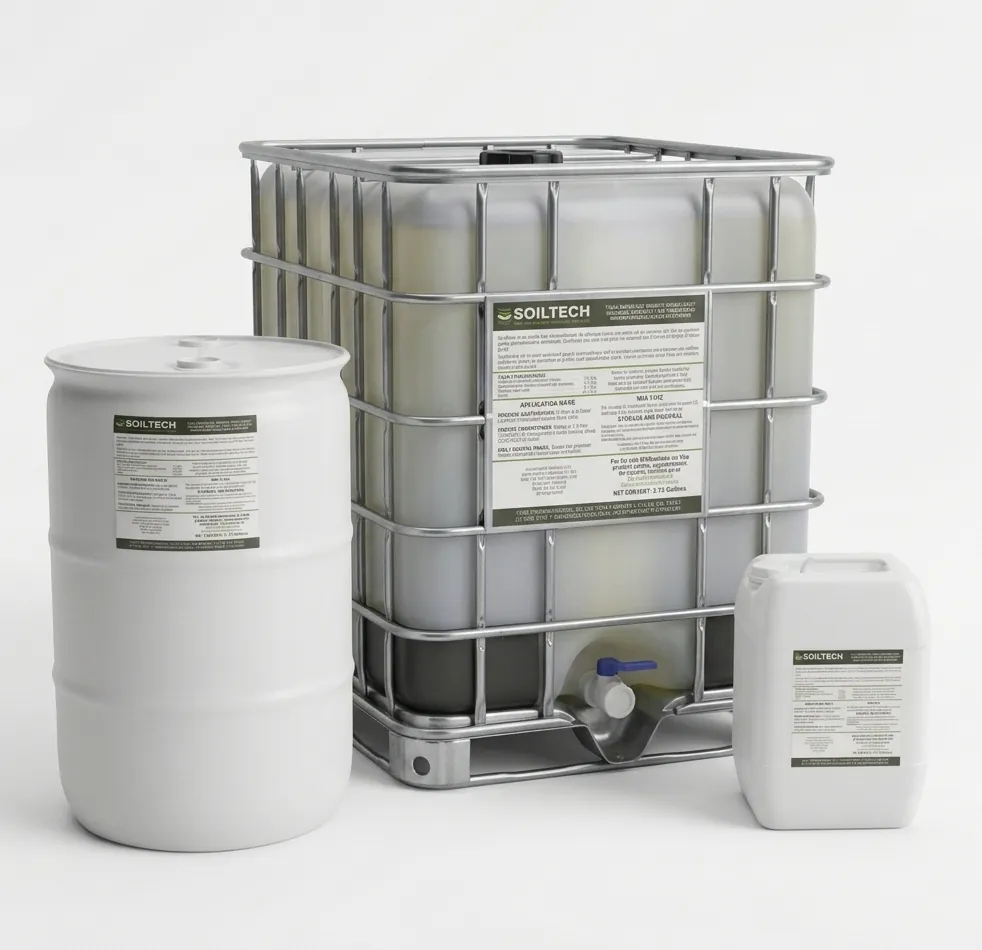
5-gallon jug, 55-gallon drum, and 275-gallon IBC tote
Safety data sheet
Non-hazardous per 29 CFR 1910.1200. Download the SDS
How it works
Alkaline and sodic soils build up excess salts that bind clay particles into a dense, compacted mass with no room for water, air, or roots to move through. SoilTech’s negatively charged polymers dissolve those salts and carry the resulting bicarbonates deep into the soil profile — well below the root zone — while the clay particles left behind combine into larger aggregates, opening connected pore space throughout.
Because it’s applied as a liquid across the full surface, every square foot gets treated — not just the roughly 3–5% of the surface a mechanical aerator’s tines can reach.

Straightforward application
01
Normal turf rate is 1 gallon of SoilTech per acre.
02
Combine with 50–200 gallons of carrier water in your existing tank.
03
Spray the full surface with standard liquid application equipment.
04
Reapply once or twice a year depending on soil conditions and traffic.
Get a quote
Share a few details and our team will follow up with pricing and a recommended application plan.